It is said that everything in the world can be found in the Mahabharata, and what isn’t there can’t be found anywhere. It’s an exaggeration, but not by much. The Mahabharata is one of the longest poems ever written, and it holds war, love, politics, philosophy, myths and, at its centre, the Bhagavad Gita.
What it is
Tradition attributes it to the sage Vyasa. It has close to 100,000 verses, about ten times the Iliad and Odyssey combined, in 18 books. It took shape over centuries, roughly between 400 BCE and 400 CE.
The story
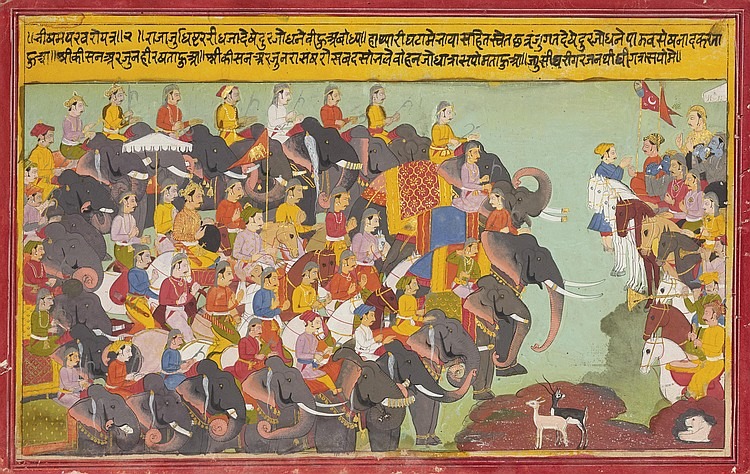
It is the story of two branches of one royal family fighting over the kingdom of Hastinapura. On one side, the five Pandava brothers: Yudhishthira the just, Bhima the strong, Arjuna the archer, and the twins Nakula and Sahadeva. On the other, their cousins, the hundred Kaurava brothers, led by the jealous Duryodhana.
The Kauravas cheat at a game of dice, humiliate Draupadi, the Pandavas’ wife, and send them into exile for thirteen years. When they return and claim what is theirs, war becomes inevitable. The great battle of Kurukshetra lasts eighteen days. Krishna doesn’t fight, but he drives Arjuna’s chariot and guides him.
The Pandavas win, but the cost is terrible: almost everyone dies. There is no happy ending, only an open question about the meaning of victory.
A book of dilemmas
What makes the Mahabharata special is that no one is entirely good or entirely bad. Heroes make mistakes and enemies have their reasons. One question runs through the whole text: what is dharma, the right way to act, when life is complicated?
That is why the Bhagavad Gita fits so well: it appears at the very moment Arjuna no longer knows what is right.
Legacy
The Mahabharata has inspired theatre, film, dance and comics across Asia. In the West, Peter Brook’s nine-hour stage adaptation of 1985 introduced it to many people. In India, the 1980s TV series brought the country to a halt every Sunday.
On the mat
Arjuna was a great archer because of his focus: he saw only the eye of the bird he had to hit. Try trataka: gaze at a candle for a minute without blinking too much, close your eyes and watch the inner image. A focused mind, like Arjuna’s.
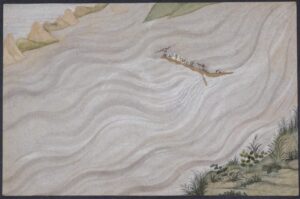
Image: the Pandava and Kaurava armies, Indian painting, Wikimedia Commons, Public domain.
Source: Wikipedia.