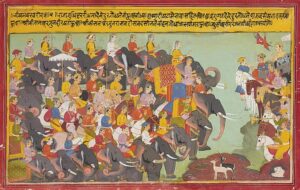
Two armies face each other. A warrior, Arjuna, asks his charioteer to drive into the middle of the field. He looks at his enemies and sees cousins, teachers and friends. He drops his bow and says he will not fight. His charioteer is Krishna, and his answer is the Bhagavad Gita, “the Song of the Lord”.
What it is
The Gita has 700 verses in 18 chapters. It isn’t a separate book: it is part of the Mahabharata, India’s great epic. Scholars date it roughly between the 2nd century BCE and the 2nd century CE. It is one of the most read and commented texts in Indian history, and one of the first to be translated into a European language, into English in 1785.
Arjuna’s dilemma
Arjuna is frozen: if he fights, he will harm his own people; if he doesn’t, he fails his duty. It’s a dilemma we all know on a smaller scale: what do you do when every option hurts? Krishna doesn’t give him an easy answer. He offers him a different way of looking at action, the self and life.
Three paths of yoga
The Gita speaks of several paths to inner freedom:
Karma yoga, the path of action. Do what is yours to do, with full attention, but without clinging to the result. Work done well is itself the practice.
Bhakti yoga, the path of devotion. Offer what you do with love, to God, to life or to others.
Jnana yoga, the path of knowledge. Understand the difference between what changes (body, emotions, thoughts) and what does not: the witness who observes it all.
The Gita also speaks of meditation, a steady mind and equanimity: being at peace with success and failure alike.
Why it matters for yoga
If Patanjali’s Yoga Sutras explain how to still the mind, the Gita explains how to live in the world with that still mind. It is a yoga for daily life: for work, relationships and hard decisions. Gandhi saw it as his spiritual guide, and many modern teachers have written commentaries on it.
On the mat
Try karma yoga today: choose a simple task, like washing the dishes or holding a pose, and do it with full attention, without thinking about finishing or how well it’s going. Just the action, here and now.
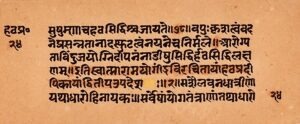
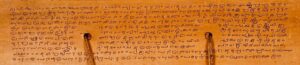
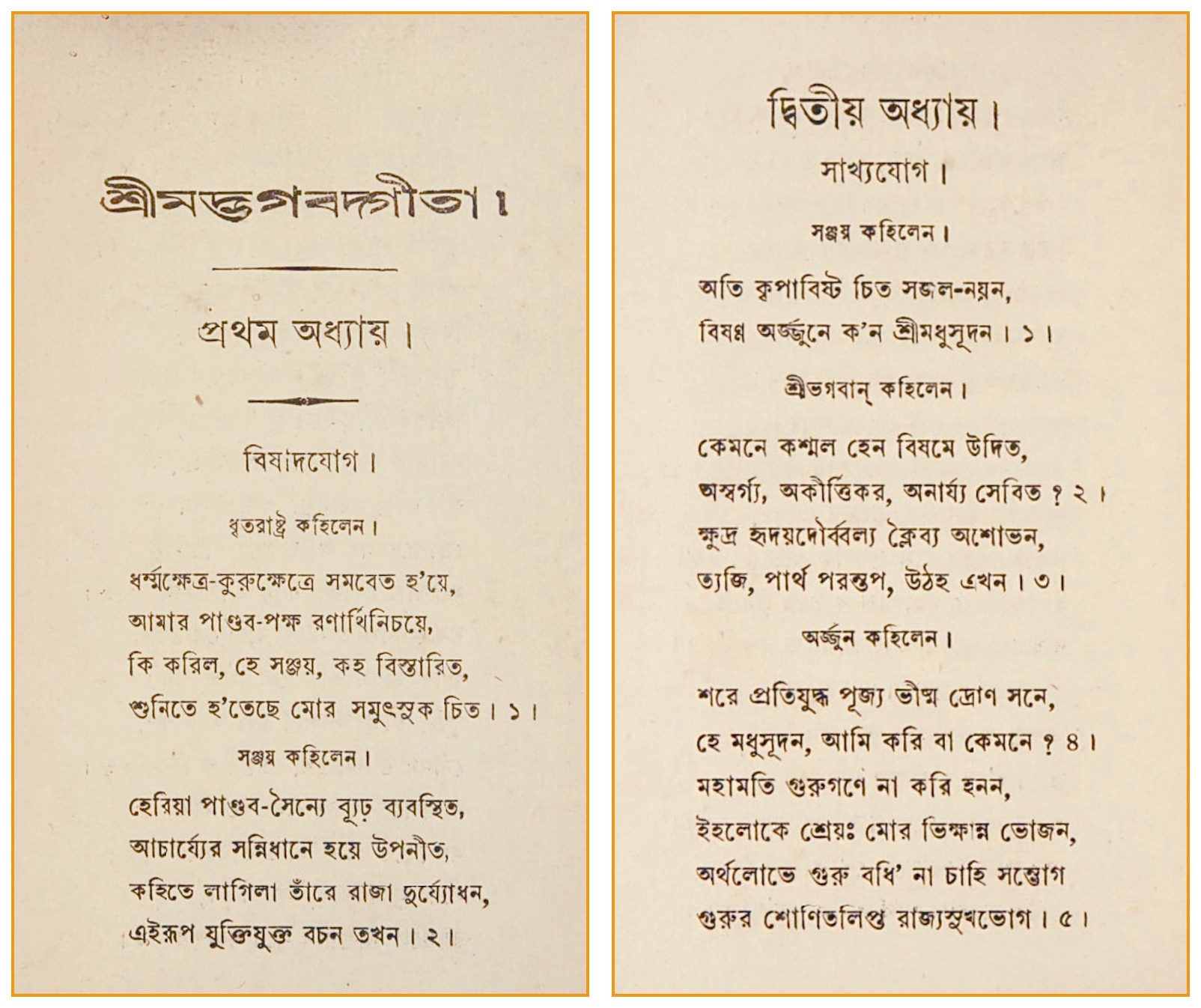
Image: opening pages of a 19th-century Bhagavad Gita in Bengali script, by Ms Sarah Welch, CC BY-SA 4.0.
Source: Wikipedia.