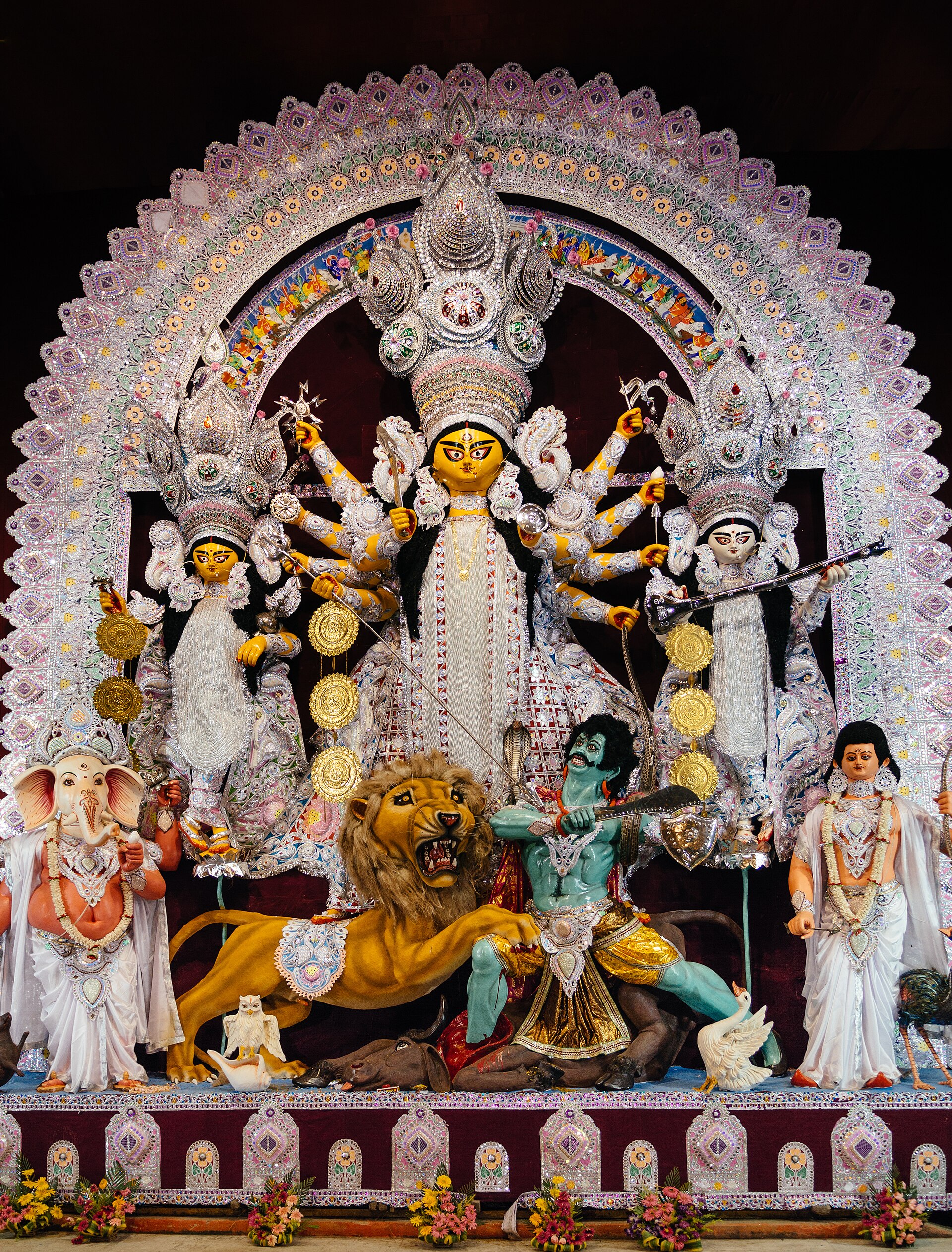
*Shubho Durgotsav!* Durga Puja is celebrated with immense fervour in the heart of West Bengal and, across India, by devotees of the goddess Durga. The festival centres on countless pandals, elaborately decorated pavilions. It marks the homecoming of the goddess and her four children, Saraswati, Lakshmi, Ganesh and Kartik, to her parents’ home. Its roots are medieval, but it has grown into a huge socio-cultural event that crosses every boundary and grows stronger each year.
Durga’s victory over evil
Durga Puja commemorates the victory of good over evil, based on the myth of Durga’s triumph over the demon king Mahishasura. It holds immense significance for the Bengali community: the goddess is believed to visit her earthly home at this time to bless her devotees. It is a profound expression of faith, devotion and unity.
A tradition centuries in the making
In Bengal, Durga Puja dates back at least to the 11th century, when it was held in spring. A distinct tradition arose when Rama, hero of the Ramayana, performed it in autumn before his battle with Ravana. The festival as we know it began to take shape in the 16th century, when aristocrats such as Raja Kangsanarayan and Bhabananda Majumdar organised lavish celebrations. Kolkata saw its first Durga Puja in 1610, thanks to Laxmikanta Majumdar, founder of the Sabarna Roy Chowdhury family, who played a key role in the city’s founding.
Boundless creativity
In Kolkata the festival has become a dazzling display of creativity thanks to “theme pujas”: temporary pandals carefully built around a central theme, with idols and decorations by celebrated artists, lighting designers and sculptors. Awards recognise idol design and environmental sustainability.
The streets of Kolkata
The festival spans ten days of rituals, peaking over five glorious days: Sasthi, Saptami, Ashtami, Navami and finally Dashami. Kolkata becomes a vast carnival: millions of people in festive clothes fill the streets, and the city echoes with the dhaak, the traditional Bengali drum. Religious and social barriers dissolve and a spirit of unity fills the air.
Experiencing it
- Visit the pandals, each telling its own story through its theme.
- Wander among spectacular lights that turn the streets into a sea of colour.
- Join locals in their finery, pray at the pandals and taste Bengali food at street stalls.
- Take part in cultural programmes and social gatherings.
- On the last day, watch the idols paraded through the city and immersed in water: the goddess returns to her home in the Himalayas.
Much more than a festival
Durga Puja is culture, faith and creativity woven together. UNESCO has recognised it as Intangible Cultural Heritage, a testament to its importance. A living canvas of art and devotion.
Where and when
In Kolkata and across West Bengal, in autumn; in 2026, from 17 to 21 October. Entry is free.
Source: Incredible India – Durga Puja.
Image: Subhrajyoti07, Wikimedia Commons, CC BY-SA 4.0.