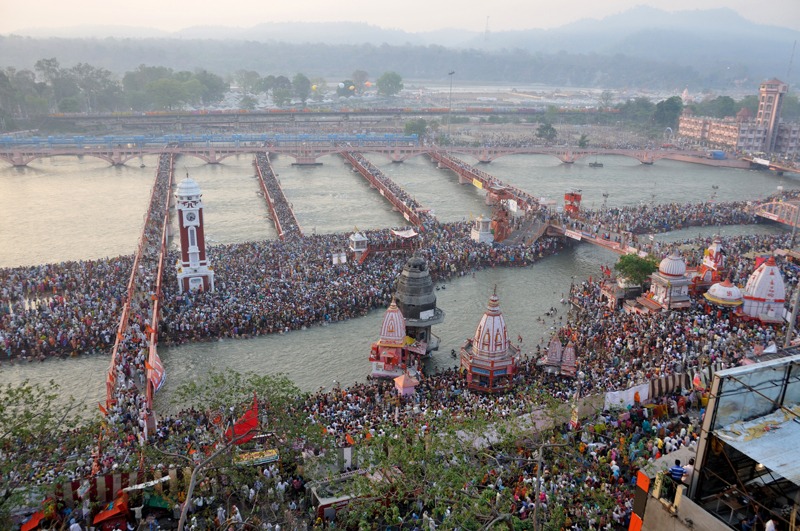
The Kumbh Mela, the “festival of the sacred pitcher”, is the largest peaceful gathering of pilgrims on Earth. For a few weeks, millions of people gather on the banks of a sacred river to bathe. No one is formally invited, and everyone comes, regardless of caste, creed or gender. In 2017 UNESCO inscribed it on the Representative List of the Intangible Cultural Heritage of Humanity.
Why they bathe
Devotees believe that bathing in the Ganges, and in the sacred rivers of the Kumbh generally, frees them from sin and from the cycle of birth and death (samsara). It is not just a bath: it is an act of purification many wait their whole lives for.
The legend of the pitcher
The name comes from an ancient story. When gods and demons churned the cosmic ocean (the samudra manthan) to obtain amrita, the nectar of immortality, a pitcher (kumbh) emerged. In the struggle over it, drops of nectar fell in four places in India. Those four places are the four Kumbh cities.
Four cities, one cycle
The Kumbh Mela rotates between four cities, taking place every four years in one of them:
- Prayagraj (formerly Allahabad), where the Ganges, the Yamuna and the mythical Saraswati meet.
- Haridwar, where the Ganges leaves the Himalayas.
- Ujjain, on the Shipra river.
- Nashik, on the Godavari.
The dates are set by astronomy and astrology, above all the positions of Jupiter, the Sun and the Moon. That is why, as UNESCO puts it, the Kumbh combines astronomy, astrology, spirituality, ritual and social and cultural customs. In 2025 Prayagraj hosted an exceptionally large Maha Kumbh. The next editions planned are in Nashik (2027) and Ujjain (2028).
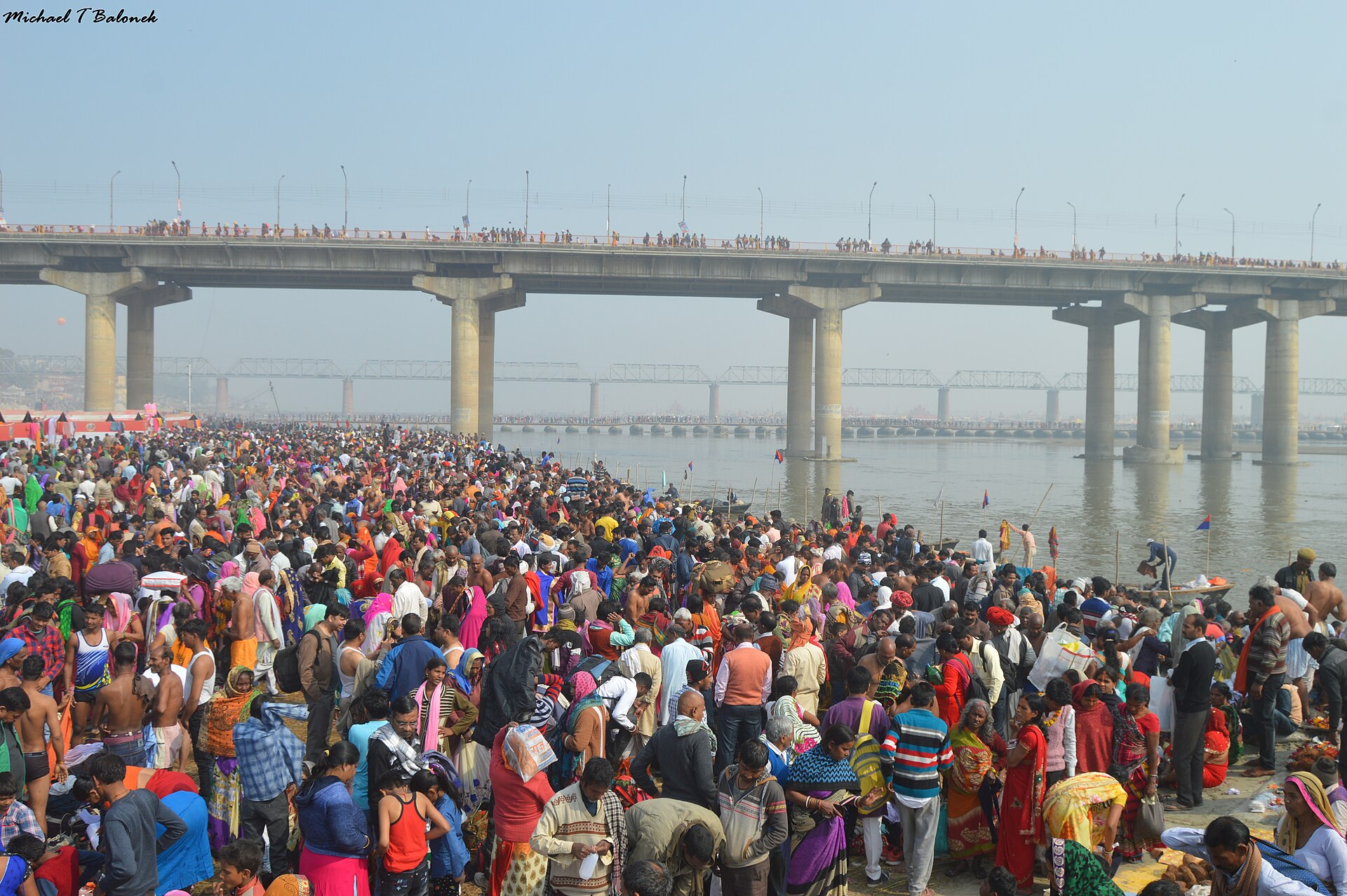
Who is there
UNESCO highlights the diversity of those who take part:
- Ascetics, saints and sadhus, often organised in akhadas, monastic orders with centuries of history. Naga sadhus, naked and smeared with ash, lead the great processions to the river on the main bathing days.
- Kalpavasis, aspirants who spend a period, often a whole month, living austerely on the riverbank in prayer, fasting and study.
- Pilgrims and visitors from all over India and beyond.
The tradition is kept alive mainly by members of akhadas and ashrams, religious organisations and people who live on alms.
How it is passed on
Knowledge of the Kumbh is handed down through ancient religious manuscripts, oral traditions, historical travelogues and scholarly texts. But the most important channel is the teacher–disciple relationship between sadhus in the ashrams and akhadas. Because it takes place in four different cities, each edition also has its own local social and cultural activities.
A city that appears and disappears
To host millions of people, an entire temporary city is built on the riverbank: tents, pontoon bridges, community kitchens, medical services and roads. When the festival ends, it is taken down. Few images explain impermanence better.
If you want to go
- Check the dates carefully: the main bathing days bring millions of people together in a few hours.
- Accommodation: book well in advance. There are tent camps for visitors.
- Safety: avoid the busiest moments if you are inexperienced, stay near the exits and agree a meeting point with your group.
- Respect: ask before photographing sadhus and people bathing.
A reflection on the mat
You don’t need to go to India to understand the Kumbh. At the end of your practice, in savasana, imagine releasing into the river whatever no longer serves you. Without judging it, just letting it go with each exhale. To purify, after all, is to make space.
Source: UNESCO – Kumbh Mela.
Image: Coupdoeil / Philipp Eyer, Wikimedia Commons, CC BY-SA 3.0.