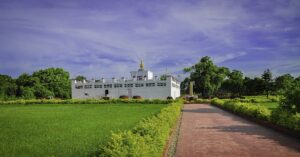
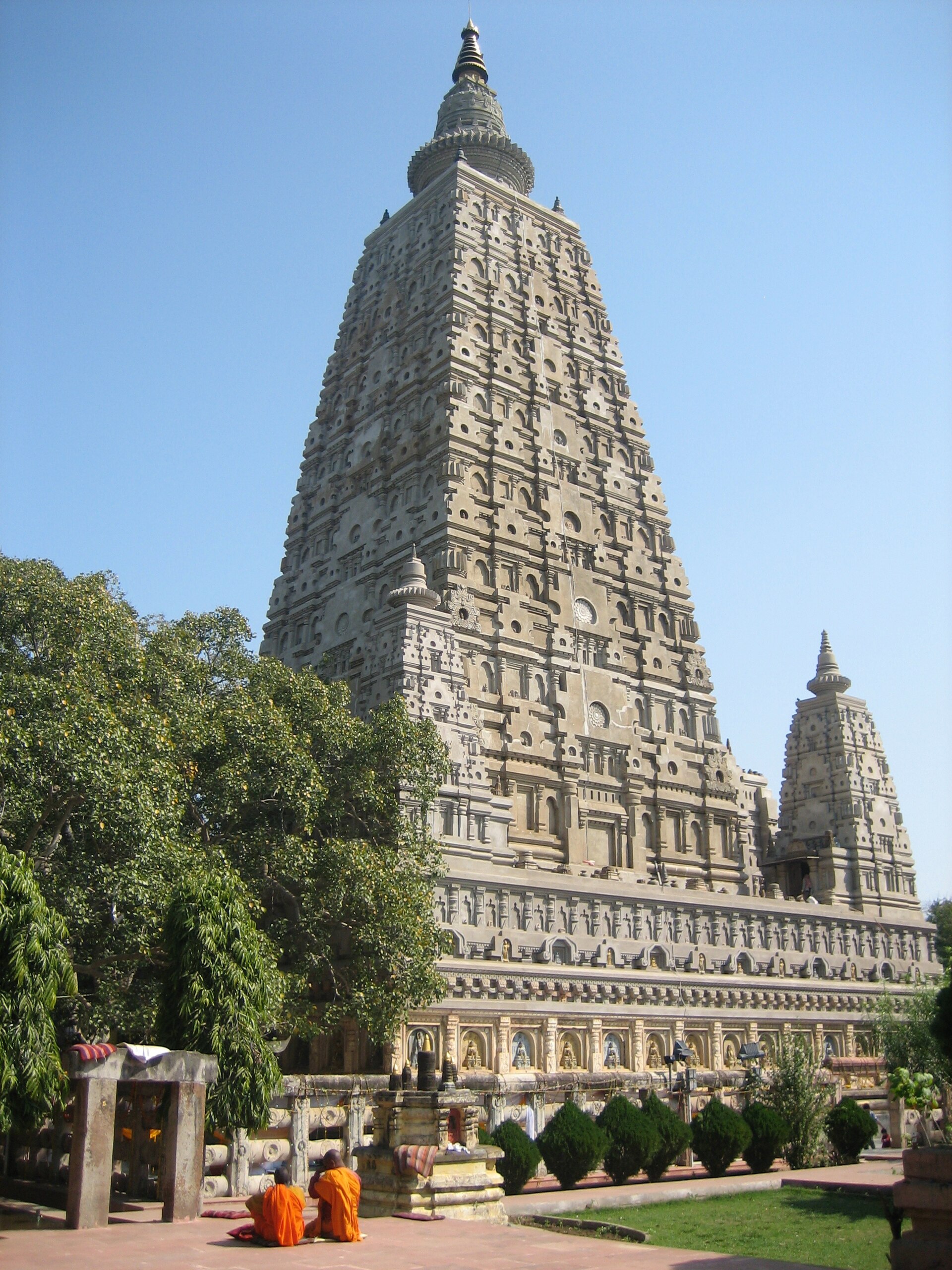
Bodh Gaya, in the Indian state of Bihar, is where Prince Siddhartha attained enlightenment and became the Buddha. It is one of the four holy sites of the Buddha’s life, alongside Lumbini (birth), Sarnath (first teaching) and Kushinagar (passing), and today it is revered as the holiest place of Buddhist pilgrimage in the world, the cradle of Buddhism. The Mahabodhi Temple Complex has been a World Heritage Site since 2002.
It lies about 115 km south of Patna, the capital of Bihar, and 16 km from the town of Gaya.
A temple with 2,300 years of history
The first temple was built by Emperor Ashoka in the 3rd century BC, when he came to worship the Bodhi tree. The present temple dates from the 5th or 6th century, the late Gupta period. It is one of the oldest Buddhist temples in India built entirely in brick that is still standing, and it had a major influence on the development of brick architecture for centuries.
The site has had its ups and downs: it was largely abandoned between the 13th and 18th centuries, extensively restored in the 19th century, and further work was done in the second half of the 20th. Even so, it has kept its original form.
The great temple
The main temple is about 50 metres high, with a curved tower (shikhara) crowned by traditional Indian temple elements. It has niches with images of the Buddha, four small shrines at the corners and entrances from the east and north. It faces east. The sanctum holds a gilded statue of the seated Buddha, over a metre and a half tall, touching the earth with his hand: the gesture with which he called the earth to witness his enlightenment. Upstairs is a hall where senior monks gather to meditate.
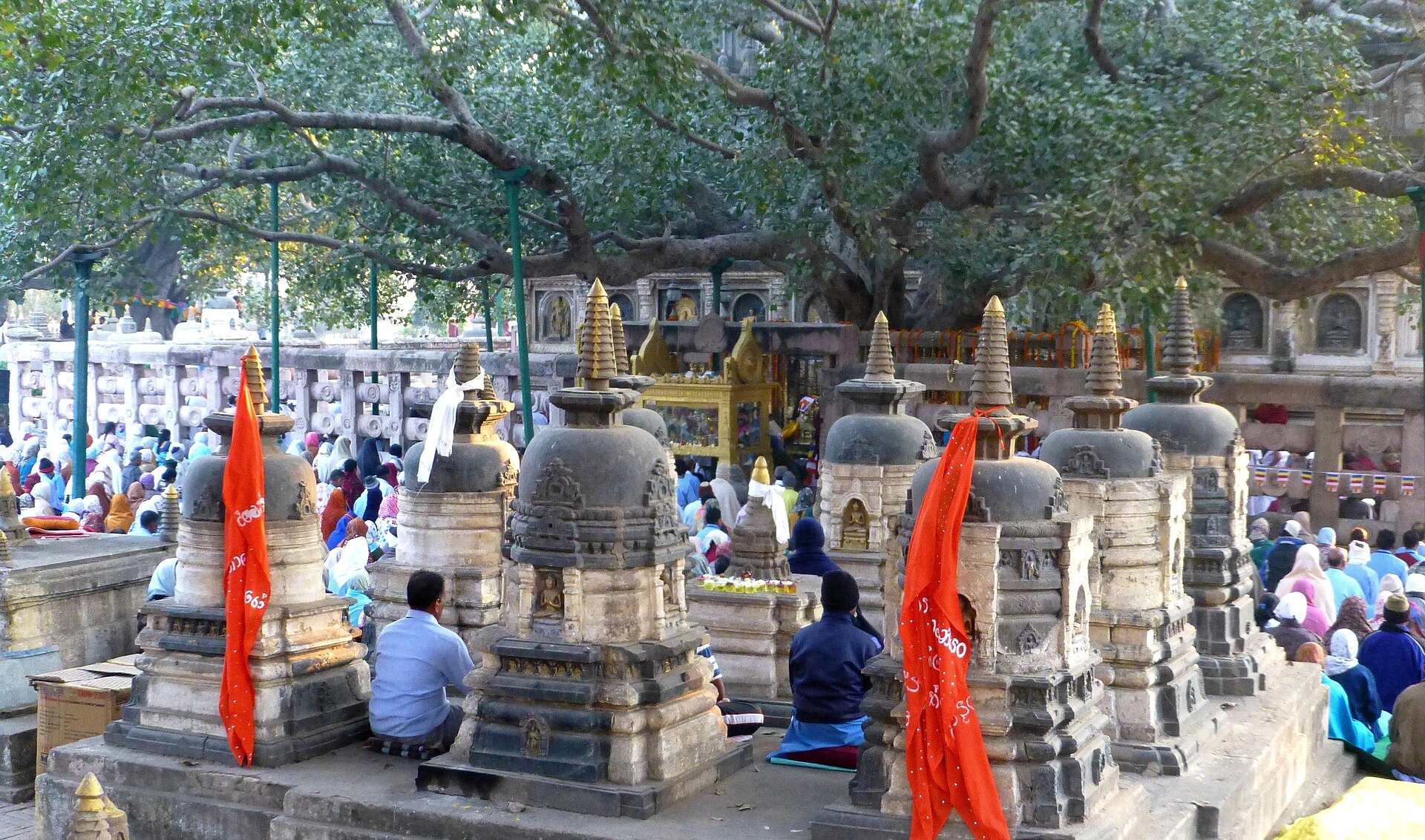
The whole complex sits about 5 metres below the surrounding ground. You reach it down a flight of steps from the east, along a long central path lined with votive stupas.
The seven weeks after the awakening
One of the most beautiful things about the site is that it marks where, according to tradition, the Buddha spent each of the seven weeks after his enlightenment:
- The Bodhi tree, west of the temple: a direct descendant of the original tree. Here he spent the first week and attained enlightenment.
- Animeshlochan Chaitya: the prayer hall where he is believed to have spent the second week, gazing at the tree without blinking.
- Ratnachakrama, the jewelled walkway: in the third week he walked eighteen paces back and forth. Stone lotuses mark his steps.
- Ratnaghar Chaitya, to the north-east: the fourth week.
- The Ajapala Nigrodh tree, marked by a pillar: the fifth week, answering the questions of Brahmins.
- The Lotus Pond, to the south: the sixth week.
- The Rajyatana tree, to the south-east: the seventh week.
The diamond throne
Beside the Bodhi tree is the Vajrasana, the “diamond throne”: a platform of polished sandstone that Ashoka installed to mark the exact spot where the Buddha sat in meditation. A stone balustrade once surrounded it. Only a few original pillars remain, but their carvings of faces, animals and ornaments are among the earliest examples of stone relief sculpture in India.
Along the central path there are also footprints of the Buddha carved in black stone, from the 3rd century BC, when Ashoka made Buddhism the state religion and placed thousands of such stones across his kingdom. There is also a memorial to a Hindu mahant who lived here in the 15th and 16th centuries, and a cluster of votive stupas built by kings, princes, nobles and ordinary people, from the simplest to the most lavish.
Why it matters
UNESCO considers it exceptional for several reasons: its brick architecture, the influence it had, its carved balustrades and, above all, its direct link to the moment the Buddha reached supreme insight. An event that, as UNESCO notes, has shaped human thought and belief.
Who looks after it
The complex belongs to the State Government of Bihar, which manages it under a 1949 law through the Bodhgaya Temple Management Committee, with technical guidance from the Archaeological Survey of India. It is funded mainly by devotees’ donations. The big challenge is development pressure around it: protecting not just the temple but the setting and landscape linked to the Buddha’s life.
Visiting Bodh Gaya
- Getting there: Gaya airport is a few kilometres away, and Gaya railway station about 16 km.
- When to go: October to March. In winter monks and pilgrims gather from all over the world, and Buddha Purnima (April–May) is especially intense.
- Respect: go barefoot, walk clockwise around the temple and keep silent in meditation areas.
- Nearby: monasteries built by Buddhist countries from across Asia, each in its own style.
A practice
Sit comfortably with a straight back. Rest your left hand in your lap and let the fingers of your right hand touch the ground beside your knee: this is bhumisparsha mudra, the gesture of calling the earth to witness. Breathe for a few minutes, feeling the contact with the ground. When the mind wanders, come back to the hand touching the earth.
Source: UNESCO – Mahabodhi Temple Complex at Bodh Gaya.
Image: Bpilgrim, Wikimedia Commons, CC BY-SA 2.5.