At the foot of the Himalayas, the Kathmandu Valley is one of the places where you can most clearly see how Hinduism and Buddhism have lived side by side and blended over the centuries. It has been a World Heritage Site since 1979, not for one monument but for seven ensembles that together show the full historical and artistic richness the valley is famous for.
The seven ensembles
- Kathmandu Durbar Square (Hanuman Dhoka): the old royal palace and its temples, in the heart of the city.
- Patan Durbar Square: palaces, temples and public spaces in one of the valley’s great craft cities.
- Bhaktapur Durbar Square: the city that best preserves its traditional layout and way of life.
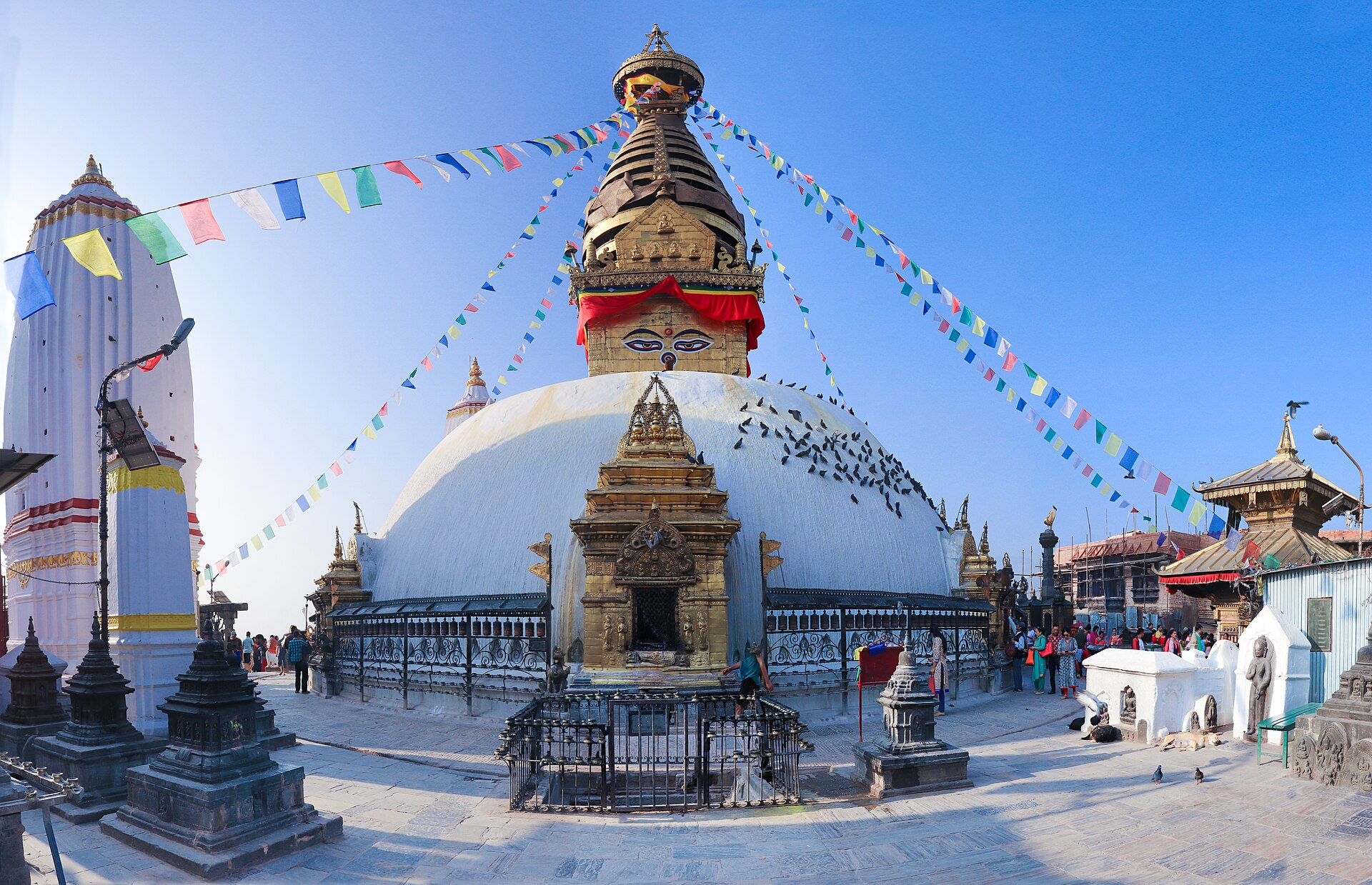
- Swayambhu: the oldest Buddhist stupa in the valley, on a hilltop.
- Bauddhanath (Boudhanath): the largest stupa in Nepal.
- Pashupati: a vast Hindu temple precinct devoted to Shiva on the banks of the Bagmati river.
- Changu Narayan: a traditional Newar village and Hindu temple complex with one of the oldest inscriptions in the valley, from the 5th century.
Tiered temples and stupas with eyes
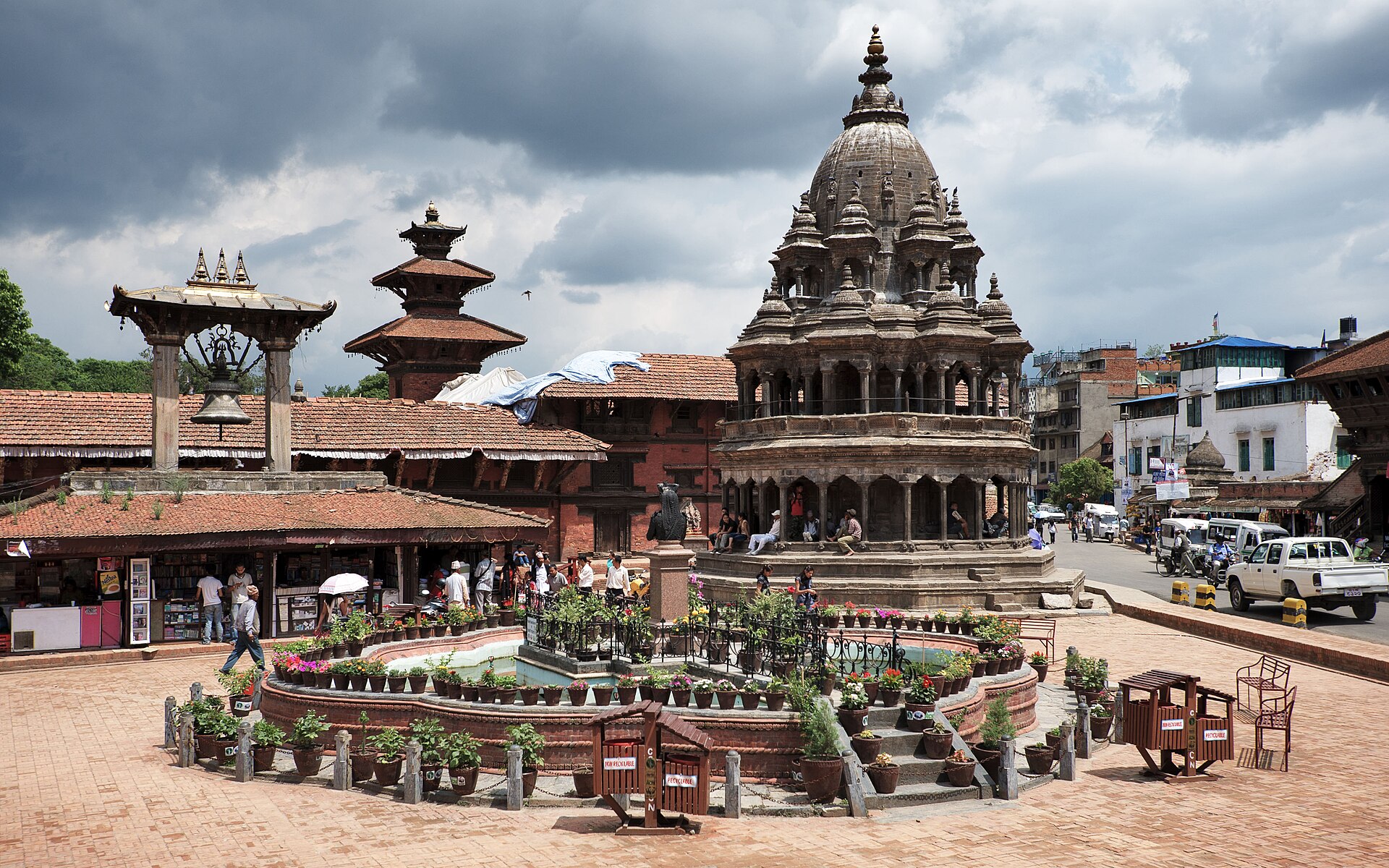
The valley’s architecture is unmistakable. The tiered temples are mostly built of fired brick with mud mortar and timber frames. Their roofs are covered with small overlapping terracotta tiles and decorated with gilded brass. Windows, doorways and roof struts carry exquisite carving.
The stupas, by contrast, have simple, powerful forms: huge whitewashed domes supporting a gilded cube painted with the eyes of the Buddha, gazing in all four directions.
The Newars, master craftspeople
All of this is the work of Newar culture, the multi-ethnic people who settled in this remote Himalayan valley over the past two thousand years. Their urban society developed some of the most refined craftsmanship in the world in brick, stone, timber and bronze.
Hinduism and Buddhism both flourished in Nepal and, from at least the 5th century, produced a powerful artistic and architectural fusion. It reached its peak between 1500 and 1800. Hinduism, Buddhism, animist rituals and Tantrism also coexist and intertwine here, a combination UNESCO considers unique. The symbolic and artistic values are not only on the façades: they show in the layout of the cities and in a landscape bound up with legends, rituals and festivals.
A living, fragile heritage
What makes the valley special is that it is not a museum. The temples are active places of worship, the squares are markets and meeting places, and the traditional urban fabric is still alive despite massive urbanisation.
That is exactly why it is fragile. From 2003 to 2007 it was on the List of World Heritage in Danger because of development pressure. In 2006 the boundaries of the seven ensembles were redefined, and in 2007 an Integrated Management Plan was adopted, reviewed every five years. A key part of it is disaster risk management: the 2015 earthquake caused heavy damage in the valley, and many monuments have had to be restored.
All seven ensembles are protected under the Ancient Monument Preservation Act of 1956, the highest level of national protection.
Visiting the valley
- Getting there: Tribhuvan International Airport in Kathmandu. Patan and Bhaktapur are close by and each makes a good day trip.
- When to go: October–November and March–April, with clearer skies and pleasant temperatures.
- Tickets: the Durbar squares and some sites charge foreign visitors an entry fee.
- Respect: at Pashupati only Hindus may enter the main temple, and the riverbanks have cremation ghats, so be discreet. At stupas, walk clockwise and turn the prayer wheels with your right hand.
- Tip: go to Boudhanath at dusk, when the Tibetan community walks around the stupa in prayer. It is one of the valley’s most beautiful moments.
A practice
Try a walking meditation in the spirit of circling the stupa. Walk slowly in a circle, clockwise, matching each step to your breath. If you like, silently repeat a simple mantra such as Om mani padme hum. Ten minutes is enough to feel the mind settle.
Source: UNESCO – Kathmandu Valley.
Image: Nabin K. Sapkota, Wikimedia Commons, CC BY-SA 4.0.