Paul Grilley is regarded as the pioneer who shaped yin yoga as it is practised in studios around the world today. In an interview with *Yoga Spirit* magazine, he explains where the style comes from and why, in his view, there is nothing new about it.
Where yin yoga comes from
Grilley learned yin in 1988 from Paulie Zink, as part of his Taoist yoga programme. Zink came from martial arts, and yin stretches were part of his training. At first Grilley advertised his studio classes as “Taoist yoga”. But when he published a book on the practice, it didn’t feel right to use that name, since it was only the yin part of a broader Taoist programme. He called it *Yin Yoga*, a name his colleague Sarah Powers was already using in her classes and that people knew.
What makes it different
Many people confuse yin with restorative yoga. Grilley clarifies: yin yoga is designed to put healthy stress on the fascia of muscles and joints. Other quiet styles, such as restorative, aim to relax muscular tension, not to stimulate the fascia.
Is it safe for the joints?
Some say yin stretches connective tissue to an unsafe degree. Grilley replies that healthy stress on connective tissue is good for the joints. With age, fascia gradually shortens and stiffens: this is called contracture, which is different from muscular contraction. In his view, yin can slow and even reverse this normal ageing process.
Meridians and nadis
His yoga teacher, Dr Hiroshi Motoyama, spent decades developing the theory that acupuncture meridians are fluid channels located in the fascia. That is why Grilley uses his vocabulary when explaining yin yoga. Motoyama’s books include *Theories of the Chakras*, comparing Chinese meridians with the nadis of Indian tradition. He concluded that the two systems are comparable, but the meridian map, with its acupuncture points, is more detailed, so he used it in his scientific studies.
Yin and yang
Do we need both a yin and a yang practice? Grilley says we need yin and yang exercise, but not necessarily yin and yang yoga. Other yang activities can be as useful as dynamic yoga: dance, martial arts or weightlifting.
Why it is so popular now
Because people tuned in to their bodies are rediscovering gentle yoga. Most people equate exercise with yang activity (running, dancing, lifting), and most modern yoga classes are yang too: power, flow, ashtanga, hot yoga… But as we age, fascia contracts and stiffens, and yang activity doesn’t address that well. The ancient yogis developed postures to counter this inevitable contracture.
Grilley sums it up with a challenge: read yoga books published before 1985. You’ll find a slow, gentle, easy yoga, very yin. Before the 1990s, most yoga was like that. Yin yoga isn’t new: people are rediscovering it.
What a yin class is like
- Few poses, mostly on the floor, seated or lying down.
- Long holds: 3 to 5 minutes per pose, or more.
- Relaxed muscles: you go to a gentle sensation and stay, without forcing.
- Stillness: once in the pose, you move as little as possible.
- Come out slowly and rest for a moment between poses.
A 15-minute yin practice
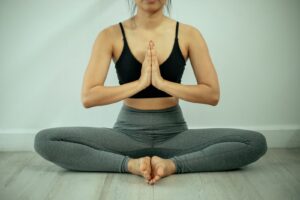
- Butterfly (yin version of baddha konasana): seated, soles of the feet together, let your torso fold forward. 4 minutes.
- Sphinx: lying on your front, propped on your forearms. 3 minutes.
- Supine twist: 3 minutes each side.
- Savasana: 2 minutes.
Breathe calmly and notice how sensations change. At Omshanti we teach yin yoga on Tuesday evenings.
Source: Yoga Spirit – Paul Grilley interview.